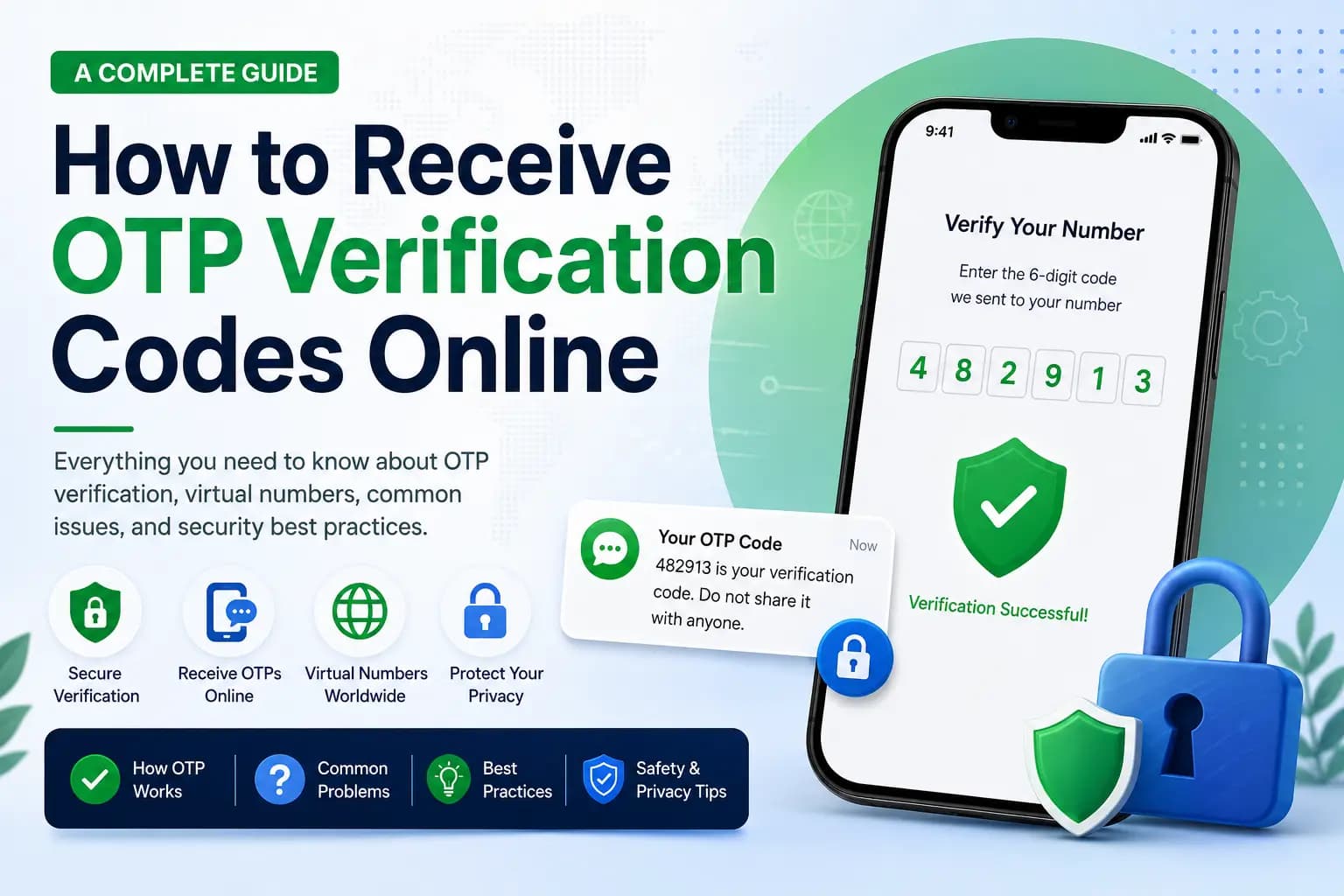
If you have ever been through an account registration, two-factor authentication upon signing in from a new device or confirming any important action online, I am sure you've come across an OTP(One Time Password). This string of numbers takes the form of a QR Code, which may be as basic as it sounds but is essential to most modern digital security.
The one time password (OTP) is a temporary verification code to verify whether the person attempting an entity can access a specific phone number/email address/ authentication device.
You may have come across OTP in the format of SMS, this is widely used because it is what we were comfortable with and easier to implement. But getting a code is not always easy. You may experience delayed messages, unsupported phone numbers, and extra limitations for international users.
But this leads to the most common question how can you get OTP verification codes online and what you should know before using a virtual number.
Let's break it down.
OTP stands for One-Time Password. It is a one-time code that is generated against a particular verification request.
An OTP is typically: (1 unlike a regular password
Valid for a limited period.
Used for verifying just one time.
Generated automatically.
Which serves as an extra level of security.
Via SMS, email or an authentication app
A service asks you to validate your phone number, sends a code — most likely six digits long like 482913 — invites you to type this firm on their site or in their mobile app. At this point you type that code in to the screen where it asks for verification, and the service verifies if the code matches what it produced.
So, verification is successful if it matches and not expired.
The process is fairly straightforward.
You want to make it sure that anyone visiting your app or website would be asked for their phone number.
A temporary verification code is generated on the platform.
A SMS with the OTP is sent to the phone number you used while verifying.
You enter the received OTP on the website or application.
The platform verifies the authentication code and its validity duration.
If it matches everything, then it verifies your phone number.
It is a simple way for services to verify that the user owns the number they are attempting to register.
Many use cases exist for OTP authentication.
For instance, when you create a new account, a service might ask for an OTP
There are platforms that send you an OTP as a second factor when logging into your account.
A One-Time Password (OTP) can assist you in identifying yourself when recovering access to one account.
There are industries, like financial services and other sensitive uses, who may use temporary codes as secondary confirmations of certain actions.
Phone verification: Adding a phone verification can help slow down the rate at which automated systems or malicious users create accounts.
Having said that: SMS OTP is not without its downsides. It's just one layer of security and not a magical shield against all sorts of attacks.
Correct; the OTP messages, while in a proper situation can arrive through internet-accessible telephony services.
Unlike a real phone number, which can only be used with an actual physical SIM in your personal telephone, a virtual phone number uses telecommunications infrastructure.
When an SMS arrives, it will be forwarded to you in accordance with the provider and the service that sends a message — e.g. via some online dashboard or another interface supported [7].
Important caveat: not every website supports every virtual or temporary number.
A few services are designed to explicitly limit the use of VoIP, virtual, disposable and/or numbers that were used before. Some may call for a mobile number from specific countries or carriers.
Check the terms and verification requirements of the service before using an online number.
Virtual number is not necessarily linked to a physical SIM card like traditional except a mobile number.
There are many legitimate uses of virtual numbers:
Business communications.
Customer support.
International communications.
Software and app testing.
Privacy-conscious registrations where permitted.
Separating personal and professional communications.
A handful of virtual-number services offer SMS reception.
For OTP verification, the real question is not whether a number is "virtual" or not. The question is whether the particular service you are using actually supports verification of that type of number or not.
So, here's what it generally looks like if you are utilizing an online phone number for any actual verification process.
Search for an SMS messaging provider that clearly lays out its phone-number availability, supported countries, SMS capabilities and privacy practices.
Select a digit that corresponds to the country/service obligations you are intending to meet.
Ensure the type/other phone you wish to use before requesting an OTP from the site/application.
This task can spare you a migraine later on.
Use the virtual number to fill in the verification form on the platform.
If the indicated number is supported by the service, a verification message should be sent.
Last but not the least, should the provider allow for incoming SMS, you might find your verification code right on its online interface.
Input the code onto the original application or website before it expires.
Отправляйте только тогда, когда этот номер не был принят в сервисе, иначе — не парите голову из-за повторных запросов кодов. Consult the platform requirements or an approved alternative.
There is nothing more annoying than looking at a verification screen and the OTP does not appear.
There are several possible explanations.
SMS messages may take longer to arrive if there is an issue with the carrier or routing.
An OTP sent elsewhere by an incorrect digit.
No Virtual, VoIP or Temporary Numbers Are Allowed by Some Platforms
Some services only send verification messages to numbers from eligible countries.
Sending multiple requests for OTPs could lead to rate limits being applied.
A one time password can have a short validity of few minutes.
There are times when the issue is not even from your side. The OTP Sending Platform may experience some technical issue.
Try these practical steps:
Double-check the phone number.
Wait a few minutes before another code request.
Verify if the service supports your country or not.
Verify that the number type is supported
Avoid repeatedly clicking "Send code."
Check for service-specific error messages.
Use an officially supported verification method.
If the problem persists, contact the platform's support team.
Hold on to the latest valid OTP in case you receive multiple and only use it unless otherwise stated by the service.
Security is highly dependent upon the PRovider, platform you are verifying with and how are you using the number.
The main problem is that of ownership and privacy numbers.
The temporary numbers some times recycled/sharing purpose. Unsurprisingly, using such a number for an important personal account would create significant security issues when multiple people could read incoming messages.
If your accounts are particularly sensitive, it's usually a good idea to use a phone number or 2FA method that you have complete control over.
NB: An OTP should be like a password.
Never send this to strangers, never publish it on the public internet, and never give it to someone who professes to be a support staff without verifying that they are indeed a true support person.
However, a real service would seldom ask you to give an auth code away to somebody else.
People try to get virtual phone numbers because they want to stop giving their personal number every site.
That can offer a degree of separation between personal communications and the rest of your online life.
But a virtual number does not mean privacy.
Before choosing a provider, consider:
Who can access incoming messages?
How long are messages stored?
Is the number dedicated or shared?
What does the provider enable collection of?
What does it do with that number after you stop using it?
Does The Service Provide Information As To Its Privacy Practices?
If you read the provider privacy policy and terms it will better help you to make a decision.
All online numbers dont work the same way.
Temporary numbers are made for temporary use. When a service allows them, and you do not require long-term access they can be convenient.
That said, they are not usually well suited to keywords and accounts that you will need to recover later.
You will be given a dedicated number for a prolonged period of time, dependent on the supplier and bundle.
The latter may make it more appropriate for ongoing communication, or services that need to keep using the same number.
It all depends on your use case for the correct choice.
OTP is not just applicable for individual users.
Verification codes are used by businesses to register accounts, authenticate users, recover passwords and prevent fraud.
Testing applications that send SMS messages may also require developers to get phone numbers.
In such cases, reporting on live numbers and sand box tools can be a preferable option when testing environments are concerned as it allows the test to go ahead without revealing details of your actual customers.
When it comes to sensitive accounts, businesses may need a more robust authentication system.
While SMS is still a prominent factor in identity verification, it is not the only avenue.
Other methods include:
Email verification codes.
Authenticator applications.
Push notifications.
Hardware security keys.
Passkeys.
Biometric authentication.
For some sensitive accounts, two-factor authentication may be dangerous than SMS alone.
NIST provides comprehensive material on digital identity and authentication.
The Cybersecurity and Infrastructure Security Agency (CISA) also issues consumer Android cybersecurity advisories.
A few good habits can go a long way, regardless if you use SMS, e-mail or an authenticator app.
They are one-time use items.
Treat them as confidential credentials.
Providers that fail to explain their policies clearly should be treated with caution.
Use a number or method of your choice to authenticate long term if you think you would need account recovery later.
When important accounts are concerned, use passkeys or authenticator apps in case supported by the platform.
You should never enter a OTP in a suspicious website just because the link was send by someone.
Using stolen OTPs, threat actors can circumvent otherwise effective security controls.
OTP stands for One-Time Password. This is a better code which is used to verify the user or authorize a certain action.
The expiration period varies according to the service. While most OTPs (one time passwords) show up to a few minutes, the exact duration might be different.
Sometimes, yes. Some virtual phone-number services receive SMS without a physical SIM card. Although, Some websites might be banned or limit use virtual numbers.
Either the code expired, or you've typed an older code, or after a different request the platform generated a new OTP.
Whether or not you can, depends on the service and its policies. There are some platforms that either let you only add the same number once in every x months or simply reject numbers already being linked to accounts.
No security method is perfect. SMS OTP does not stop at a phishing site, however — SMS OTP is useful and better than nothing when protecting an account; but since the protocol might suffer other attacks, including SIM attacks or number recycling, it would be advisable that sensitive accounts may prefer a stronger method of authentication.
Receiving OTP on phone is something you must have gotten accustomed to while surfing the internet. Whether you are registering for an account or protecting your logging in, one-time codes lend convenience to websites and applications by requiring confirmation that a phone number or other authentication channel is owned.
Online OTP verification codes are used for many legitimate reasons when you have a virtual number appropriate. But there's no one-size-fits-all solution. Virtual or temp numbers may be screened out by some platforms, and other may have country, carrier, or usage restrictions!
The most clever strategy is easy: comprehend the service demands, use a respectable carrier, guard your OTPs cyber truck camper van with trusted cloud-based hotlines and now not to sign-up temporary numbers for these accounts that you need long-run recovery from.
Convenience is nice and all, but in the realm of account security, knowing exactly what you're using, works even better.